If Ridley Scott had stopped working after his first three films, his legacy would be secure. The Duellists (1977) was an impressive debut which hinted that the British director was a master of period detail and cinematic beauty, but it was Alien (1979) and Blade Runner (1982) that would change the entire look and feel of a film genre. These back-to-back masterpieces are arguably the most influential science fiction films since 2001: A Space Odyssey (1968) and Star Wars (1977), a remarkable achievement considering they were both directed by the same man in a span of only three years (and that nothing has been released in the time since which has made nearly the same impact).
However, he did not stop after the success of those two films. He has continued to work and dabble in different genres regardless of popular or critical approval. With films like Thelma & Louise (1991), Gladiator (2000), Black Hawk Down (2002) and Matchstick Men (2003) on his resume, he's been nothing if not eclectic. Unlike someone like James Cameron who will only get off his can to make a new movie if he's sure it'll be the most profitable (and expensive) one ever made, Scott has demonstrated an almost relentless work ethic, moving on to the next project as soon as one is completed. But aside from a few Best Director nominations over the years, he never has been recognized as one of the most consistent, hard-working and flat-out talented directors in the world.
One of the reasons for this is that storytelling has never been Scott's greatest strength. He favors complex plots over straightforward ones, and it's no surprise he started as a commercial director when so many of his films are edited like trailers. Even on Alien and Blade Runner, widely accepted as his two greatest films, there are stretches where the story takes a back seat to the visuals.
But even when his films don't exactly draw the viewer in on a plot level, they still manage to be artful and eye-catching. The visuals in his films, whether they're about medieval times or the modern American military or some futuristic world, have always been stunningly gorgeous. I for one can't remember a damn thing about the plot of Kingdom of Heaven (2005), but it contains images that I know I'll never forget. What's more, the worlds he creates feel lived-in. His production designers, cinematographers and costume people actually manage to make Russell Crowe look like a man living hundreds of years ago, rather than an actor playing dress-up.
Unfortunately, this difficulty with storytelling, along with his tendency to bang out film after film, seems to have hurt his reputation over the years. His last four films, Robin Hood (2010), Body of Lies (2008), American Gangster (2007) and A Good Year (2006) have compiled scores of 53 (out of 100), 57, 76, and 47 on Metacritic. American Gangster was the lone hit with audiences on that list, and the only one to garner any nominations from the Academy. Reviews of these films have characterized Scott as a workmanlike director, a man whose filmmaking is always competent, but no longer captivating, at least not compared to his early stuff.
This characterization is unfair to Scott, as it suggests that he no longer strives for greatness in his films, even as it acknowledges their technical brilliance. The truth is Scott is still the same director he always was, constantly putting everything he's got into every movie, never selecting projects based on prestige or profitability but only based on what interests him at that time, which seems to be changing every year. Even when his films aren't easy to love, they're very easy to admire, whether or not they change the landscape of cinema like Blade Runner did.
(It hasn't helped that his recent projects have tread increasingly familiar cinematic ground - drug empire, counter-terrorism, Robin Hood - but anyone who's seen more than a few of his films will recognize his unique visual imprint on these subjects)
And the overall career of the man should rightfully place him in the pantheon of the greatest directors living today. It's easy to point to his earliest successes and conclude that nothing else he's done since has eclipsed that. Imagine if Hitchcock had made Psycho and Rear Window as his first two films, then spent the rest of his career doing romantic comedies and crime dramas. That's the type of legacy we're talking about here, which may be frustrating for some, but remains impressive in its own right. Perhaps most impressively, Scott has stayed true to himself through all of it.
There are surely some exceptions, but it seems that the 3rd season of a long-running series never turns out to be its best.
There are reasons for this.
Most shows seem to fall into one of two categories: 1) They start with such a killer concept and cast and execute it so perfectly that anything they follow up with after the inaugural season turns out to be a disappointment or 2) The ideas are there, but the execution is not, so it takes a little while for the series to really get going, but when it hits its stride, it makes all the rough early going worthwhile. This happens most often in the second season.
Then there is a pattern that follows either scenario: once a show has figured out what it wants to be (and if it's lucky enough to be renewed for longer than a season) it risks either becoming boring through reputation, or criticized for not being able to live up to its ambition.
For these reasons, third seasons often turn out to be less successful than what came before them.
(The Simpsons is a huge exception, but in this case the late-blooming renaissance that normally would occur in the second season took longer than usual).
Breaking Bad was a fantastic concept brilliantly executed from the get-go (High school teacher gets cancer, cooks meth). Its second season actually managed to up the ante in every way, creating some of the show's finest episodes.
In comparison, the third season felt more scaled-back, as if we had been flooring it plot and character-wise the whole time and the writers felt the audience needed a bit more time to breathe.
So we ended up with some episodes in the third season that felt a bit trite and underwhelming compared to what came before. The show is still likely better than anything else on the air right now, but for the first time it has put out a season that contains dead spaces, scenes that feel rushed or unnecessary, and too much focus on the less compelling aspects of the show.
And that's fine. Because the same history that shows that season 3s tend to be the weakest also indicates that many shows have been able to recover from this slump, and create seasons that are even stronger than the early ones, especially as they build towards their end.
And it's encouraging to me that even as the series has lost a lot of its narrative weight, headlong propulsion and shock value, nothing else that I've watched this year has been able to so reliably inspire such a palpable feeling of dread. It's a show that promises you bad things are about to happen, and it's the waiting for them that creates tension and suspense so suffocating it actually becomes physically stressful to watch. Like the drug that its protagonist, Walter White cooks, the show itself provides a rush and then leaves the viewer jonesing for more.
This past season provided fewer of those moments than ever, but it finished so strong that my excitement for the next season is just as high as it was for this one. And given what the show has accomplished already, I won't be surprised if we're in for its best season yet.
World War I - Paths of Glory (1957) Lawrence of Arabia is a better movie, but Paths of Glory is a better WWI movie. That's how a lot of these things are gonna work. Not which movie is the best, but which movie captured the spirit of that war the best? In this case, WWI was insane, a folly so horrifically absurd and foolish it was supposed to be the last war ever. The movie illustrates this by presenting a story of three young men randomly picked for execution by firing squad for "cowardice" during an absolutely futile battle by a general who had inadvertently killed one of his own men the night before. Kirk Douglas stars as the colonel/lawyer who attempts to defend the men in an obviously fixed military tribunal. The end result leaves you feeling shocked and hopeless, like any good war movie should. And if you liked Stanley Kubrick before he got weird, this should definitely be your favorite movie of his.
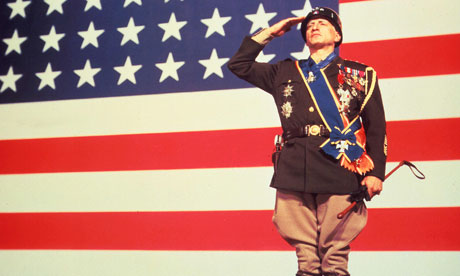
World War II - Patton (1970) If the famous opening speech written by Francis Ford Coppola and delivered by George C. Scott (and paraphrased from actual speeches by George Patton himself) doesn't epitomize everything that was wrong and right about this war, nothing does. Patton demanded nothing less from his troops than complete and utter domination, and while this method led to success on the battlefield, it became a zero sum game after the war ended and truces were to be made. That is the paradox of American military action in a nutshell. We can achieve victory, but we can't force the rest of the world to play nice when the fighting's over. Patton serves as an embodiment of this war, an old-school authoritarian who will not stand for any sissiness (publicly slapping a soldier of his who can't keep from breaking down) and who is already obsolete by the time the U.S. has won. That's the metaphor for how we treat our veterans: we take everything they have to give, and leave them with nothing.
Vietnam War - Apocalypse Now (1979) Hallucinatory, flamboyant, violent, disturbing ridiculous and somehow beautiful -- in describing the film I could be describing the period of history that spawned it. Transposing the plot of Joseph Conrad's "Heart of Darkness" to Cambodia, this film's philosophy represents a shift from war movies of the past, from which cinema has never really recovered. Fine, we can win -- but only if we are willing to revert to our savage animal instincts and sink to doing absolutely whatever is necessary to gain the upper hand. In other words, if war is hell, it's our job to be the Devil. It's a dark, dark movie but an awesome one. I personally can't get through it more often than about once a year, but whenever I do it makes me wonder if this is actually the best film ever made.
Iraq War - The Hurt Locker (2009) War is a game. That's the point we've come to. Patriotism is over as far as being a motive for fighting. The only thing left is personal victory. Winning doesn't mean anything anymore except on the absolute micro level. And the only way to win is to thwart every constant threat to your survival. And if those threats turn out to not be challenging enough, the whole thing gets rather boring. This movie is about what happens to one soldier, heading up a bomb-defusing team, when the boredom sets in for him. They say it's a movie that doesn't take any sides, but really it can be used to argue either way. It all depends what you bring to it. But the one place everyone who's seen it can agree is we're all lucky not to have to do this work ourselves.
I made my list of the top 100 albums of the last decade back in September, and overall I could still live with it. My mathematical ordering system may have been misguided, but if I'm ranking this list there are only a few ridiculous placements (Volume One & 8 Diagrams in particular aren't as good as the score would indicate).
And then, inevitably, there's all the music I'd discover after the list was completed. Here are some of the albums that would have made the list if only I'd heard them earlier:
A Fine Frenzy - Bomb in a Birdcage (2009)
A Fine Frenzy (born Alison Sudol) is the second coming of Joni Mitchell. That's a superficial comparison, since they don't sound anything alike musically or vocally, but it fits if you follow a certain logic. With her playful lyrics, ability to experiment with different pop styles, and willingness to risk sounding completely ridiculous (the "Oh-oh, oh-oh, oh-oh, oh-oh, oh-oh" hook in the chorus of "Blow Away" skirts the line between pretty and obnoxious. Either way, it is obscenely catchy), she's as versatile and potent a songwriting force we've had since the prime of Miss M.
Feist - The Reminder (2007)
I was skeptical about Feist at first. "No way she's that good," I thought. "She's a happier version of Cat Power and that's it."
Oops. Turns out her songs are some of the most haunting and loveliest of the decade, with arrangements so layered and thoughtful you can picture exactly what the video for "One Two Three Four" will look like before you even watch it. I was even wrong about her voice - not too many women in this genre sing at this almost uncomfortable level of intimacy.
Phantogram - Eyelid Movies (2009)
Phantogram are the soundtrack to the coolest dance party ever. Booming beats, sexy boy-girl vocals, and psychedelic textures create a groovy trip-hop sound that could either lull you to sleep or make your car bounce. Great multi-purpose music.
Maps & Atlases - You & Me & The Mountain (2008)
Maps & Atlases have yet to release their full-length debut; the entirety of their output so far consists of two EPs. Yet they've already built a strong cult following, thanks to their unique blend of quirky melodies, guitar pyrotechnics, and hyperactive rhythm section. The vocals are a bit rough, but if you can handle that they're an incredibly fun band to listen to -- combining math-rock chops with straightforward songwriting.
Nisennenmondai - Destination Tokyo (2009)
Three Japanese women who thrive on noise and repetition, Nisennenmondai (which supposedly means "Year 2000 problem", referring to the Y2K bug) get by on heart and creativity more than structure or melody (all their songs so far are instrumentals, and most of them just ride one groove for 10 minutes). Wendy says "This is great background music" and I couldn't agree with her more. Unless she meant it in a bad way, which I don't think she did.
Marnie Stern - This Is It and I Am It and You Are It and So Is That and He Is It and She Is It and It Is It and That Is That (2008)
Yeah, just ignore the album title. Despite having the most boring-sounding name ever, guitar goddess Marnie Stern comes on like a kid on the world's most epic sugar rush. Assisted by the monster talent of Hella's Zach Hill (perhaps the greatest drummer of his generation), her spastic, hyperactive songs are equal parts pop songwriting skill and face-melting guitar craziness. Yes, most of the press on this woman focuses on the "chick can SHRED" aspect of her sound, but these songs are as catchy as they are technically impressive, which sets her apart from the Yngwie Malmsteens of the world.
Wildbirds & Peacedrums - The Snake (2009)
They're very aptly named. Most of this Swedish couple's songs are nothing but heavy percussion and extremely passionate singing; if there's any musical accompaniment, it's about as simple as it gets. Sometimes this formula makes them sound like they're doing tribal chants or children's songs. But it works. This music is fraught with an unbearable amount of tension, the way it toys with the listener's expectations. We hear so much buildup, and expect it to culminate in a certain way -- instead it just keeps teasing us and leaves us frustrated in a weirdly satisfying way. That's how it works for me anyway. You might not like it. But it is unique, and that's what I tend to look for more than anything else these days.